In life I’ve learned that those who spend their time measuring other people’s worth rarely have their hands free to build anything of their own.
-
-
There was a time when writing, composing music, and drawing were not for everyone. You needed ideas and the know-how to execute them.
Maybe you had a beautiful painting in mind, but without the skills to paint, you would not have been able to bring that painting into existence.
Becoming rich via creative ventures was not easy for most people; there were better ways. The recompense was not necessarily in monetary compensation, but in doing something that you wanted to do and excelled at.
Art, in particular, stood the test of time.
That, too, has changed.
We now have AI-fueled artists, AI-fueled musicians, and AI-fueled journalists.It’s AI on top of AI on top of AI.
Don’t get me wrong, I love AI, I use AI, and most of all, I experiment with AI.
I have my share of AI-generated text, music, images, and whatnot. There is only one big elephant in the room.
You can still tell what is AI generated, and the content might have a great idea behind it, but it lacks authenticity. Take SUNO AI, for example, I did lots of experiments with it.
And while it offers everyone the opportunity to create their own music, starting with the lyrics and the vibe they want to achieve, the results are mostly obnoxious.
The songs are incredibly trivial, but since they trained their model on actual successful songs, the results might be catchy and even work for most people.
If you add the virality component created by unheard-of vulgarity in lyrics – there are plenty of examples in Portuguese, English, Italian, and so on, but I will not share those with you – creating a certain kind of song, might even be “monetizable” on most social media. I did that myself, but I can’t quit my job thanks to the revenue. If you are lucky, you will barely cover your AI subscription.
What is concerning is that most AI tools give you the illusion of creating, because you end up with a final, marketable product.
And this doesn’t stop at music.
Video games, books, images, and videos are created daily to capture the public’s attention. And I don’t think it’s worth it.
The problem is not low-quality AI products destroying real creativity. The problem is that those tools prevent creators from thinking. No more musical theory to apply, no more observation, re-elaboration, and execution. No more blending colors, studying perspective, reflections, and light sources.
No more writing a story, writing elegant (or not so elegant) code, it seems like everything has already been done, and thanks to the biggest plagiarism machine (most AI trained without any authorization whatsoever on the biggest data corpus EVER), you can just create your own “stuff”.
Just dump your ideas into whatever AI you want to use, and keep refining and asking to make “no mistakes” until the result is OK.
Everything may be easier to “create”, but the degradation of any form of real creativity and the media is already here.
NO AI WAS USED TO WRITE THIS. ZERO, NONE, ZILCH. THANKS.
-
+
+
+
+
+
+
I just learned that Paul Thigpen has passed away. And if you don’t know who he was, let me tell you: you should.
This was a man who went from atheism to the Presbyterian ministry to full communion with the Catholic Church in 1993. Not a casual journey. Not a comfortable one. He once said he came to believe in the devil before he came to believe in God, after encountering what he described as “powerful, malicious nonhuman intelligences.” That experience sent him running back into the arms of Our Lord, and he never looked back.
Summa cum laude from Yale. PhD in historical theology from Emory. Fifty-nine books. Over five hundred articles. Sixteen languages. Appointed by the U.S. Conference of Catholic Bishops to their National Advisory Council in 2008. Professor, apologist, catechist, musician. The man did not waste a single day.
His Manual for Spiritual Warfare became a modern classic. But what fascinated me most was his later work on extraterrestrial intelligence and the Catholic faith. Twenty-six centuries of theological reflection on whether we are alone in the universe. From St. Albert the Great to modern popes. He called it a “wondrous and noble question,” and the Church, he argued, has left the door wide open.
He was still working the day before he died. He was scheduled to be interviewed by EWTN on that very topic. That tells you everything about the man.
Everyone who knew him talks about the same thing: the kindness, the smile, the generosity. Katie Warner called him “everyone’s godfather, sponsor, mentor, and friend.” Marcus Grodi remembered his “broad smile and contagious laugh.”
Thigpen himself clung to 1 John 3:2: “We know that when He appears, we shall be like Him, for we shall see Him as He is.”
Rest in peace, Dr. Thigpen. Something tells me you’re finally getting the answers to all those wondrous questions.
🙏✝️
-
+
+
+
+
+
+
The current social media model—characterized by high ad density, almost zero revenue share for the average user, and draconian terms and conditions—is broken. Why build content for platforms that monetize our attention without fair compensation? Blogging may not solve every issue, but right now, it is the only way to truly own your voice in the chaos of the internet.
-
Puglia is shrinking, and the latest figures from Istat aren’t just dry statistics—they are a wake-up call for anyone who cares about the future of South Italy. In just the first ten months of 2025, my home region lost nearly 9,000 residents. Once the final December tally is in, we are looking at a permanent loss of over 10,000 people in a single year.
As someone born and raised in this land, it is painful to see Italy heel losing its pulse. The decline isn’t felt equally everywhere, but the trend is undeniable: Taranto and Lecce are bleeding residents the fastest, while even traditionally robust hubs like Bari are barely holding steady.
A Crisis of Cradle and Career
The math of the “demographic winter” is brutal. We are seeing a perfect storm of two factors:
- The Birth Gap: Between January and October, Puglia recorded roughly 17,000 births against over 31,000 deaths. We are simply not replacing the generations that came before us.
- The Great Migration: This isn’t just about people moving; it’s about a “fuga dei cervelli” (brain drain). Puglia has the highest percentage of university students in Italy who flee to northern regions to find an education and, eventually, a career. We are exporting our best talent and what are we importing?
The Economic Wall
Why aren’t we having children? The Istat report is blunt: a third of young Italians cite economic instability, while others point to inadequate working conditions or the sheer lack of a stable partner. In a region where the cost of living keeps rising but the “social elevator” feels stuck, many Pugliesi feel forced to choose between a family and a future.
The Surprising Safety Net
Surprisingly, the only thing preventing a total demographic collapse is international immigration. The “contribution” from abroad brought in a net positive of 11,000 units. Without these new residents, Puglia’s decline would be twice as fast. It’s a paradox: while my fellow Pugliesi head North to seek their fortune, others are coming from across the globe to fill the void we leave behind.
Puglia remains one of the most beautiful places on Earth—a land of ancient olives, baroque architecture, and deep tradition. But a land without young people is a museum, not a home. Unless something fundamental changes in the labor market and support for families, we are watching the slow, quiet emptying of the place I call home.
-
Daily writing promptYou get to build your perfect space for reading and writing. What’s it like?
A quiet, comfortable, wooden space. Filled with my favorite books, musical sheets, and a piano. Isolated from outside, a personal, safe, welcoming micro-world where only I and a few selected people have access.
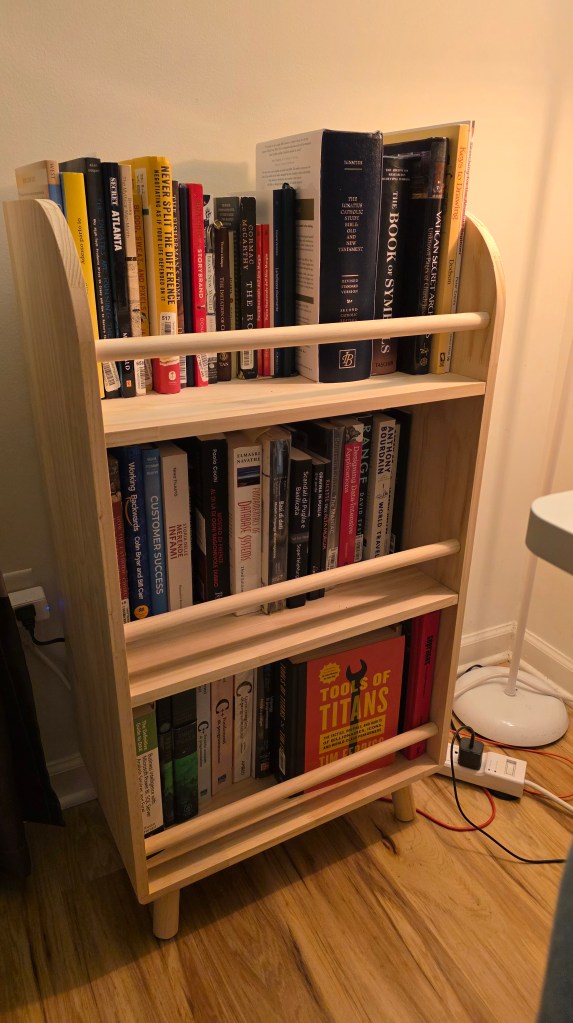
Meanwhile, I bought this small bookcase, which is already insufficient to hold all the books I have here.I really miss the books, comics, and musical scores I left behind in Italy at my parents’ house.
They are a part of my life, my education, my passions. Little by little, perhaps, I’ll have them all sent over. But when every book is transferred, when every object I left behind is back in my possession, then I’ll feel that perhaps the separation from my country of origin will be even deeper. Almost total, almost definitive.
So when people ask me what I miss most about the dear old world… Perhaps the answer is precisely: my books.
But actually, I also miss the ease with which you can stop and chat with friends and acquaintances, maybe quickly over a coffee that each of us will want to pay for the other.
And the unique landscapes, dotted with the small and great traditional and social differences between the various cities that, despite everything, have a single, strong root in hundreds and hundreds of years of history and traditions.
And perhaps, even more than anything else, the focaccia.
-
I love the world of social media, communication, and cooking. Above all, I love the cuisine of my home country, Italy. And rightly so, because Italian cuisine—universally recognized as one of the best in the world—has recently been declared an intangible cultural heritage of humanity.
In my opinion, this recognition is unnecessary, obvious, trivial… but nevertheless pleasing to many. I, on the other hand, am totally indifferent: the value of our cuisine certainly does not need UNESCO’s stamp of approval. It is an obvious, well-known, self-evident value.
Despite this, I note with a hint of concern the spread of countless American restaurants and dishes in Italy. As an Italian citizen by birth and an American by naturalization, I find this almost incomprehensible. Why would anyone bite into a lobster roll when they can enjoy a mouthwatering sandwich with ingredients that are either impossible to find or extremely expensive in the rest of the world?
I am thinking of real Parma ham, mortadella from Bologna, and local cured meats which, although they do not have PDO or PGI labels, embody flavors, techniques, and raw materials where authenticity is not an option but the very foundation of their preparation.
I also consider it reductive to extend the recognition of “intangible heritage” to Italian cuisine as a whole. Ours is such a rich, unique, and diverse country that its true wealth lies in its regional, and often municipal, cuisines.
While Gravina uses the so-called “Rùccolo,” the delicious focaccia of San Giuseppe, Altamura — a neighboring city — prepares Pasticcio. Two recipes that are similar in some ways, but profoundly different, just like the dialects that describe them. Extend this argument to the entire peninsula and you will understand how truly unique our country is: a constellation of culinary identities unmatched anywhere else in the world.
So I ask myself: why open a slew of fast food restaurants serving French fries, hamburgers, smashburgers, fried chicken, and lobster rolls?
Was this globalization really necessary?
My answer, as a romantic and perpetually deluded expatriate, is a resounding no.
The extreme irony is that many of these new restaurants call themselves ‘American’ despite the fact that, for a large proportion of Italians — partly due to Trump’s second presidency — the United States is a hated, abusive, and inherently evil country.
Then, however, a “smashburgeria” opens and the lines go around the corner. I find it delusional, but not surprising. If I have understood anything about us Italians, it is that we do not behave rationally, especially when it comes to food.
You risk death threats if you use pancetta instead of guanciale in carbonara… but then everyone queues up for a lobster roll. A sandwich with lobster drenched in butter, which — for goodness’ sake — might make sense once a year, but can never reflect the authenticity of two slices of bread with tomato, good olive oil, and wild oregano.
You don’t even need salt: the flavor comes, or rather came, from real products, which we are losing.
It’s over, my friends. The proponents of this debacle are, Italian people.
Because they are the ones who welcome, applaud, and finance restaurants that offer foods that do not belong to them. Often frozen, often ultra-processed.
America has so much to offer and many dishes are fantastic, but they are certainly not sandwiches, hot dogs and various fried foods. No one in Italy offers a real blueberry pie, or a pecan pie, or Thanksgiving turkey; no one cooks authentic crab cakes or real chicken wings.
America is not just smashburgers and pancakes.
I’m thinking of Cajun cuisine from Louisiana, Texan barbecue where the flavor comes from wood and hours of smoking; I’m thinking of soul food from the Southern States, fusion cuisine from Hawaii.
America also has its own culinary excellence: less numerous than italian ones, of course, but real nonetheless. And it certainly doesn’t coincide with what some entrepreneurs hungry for money sell in Italy as “American food.”
In a world rushing towards standardization, Italian cuisine remains the last true bastion of Italianidentity: not a brand, not a label, but a living heritage made up of hands, dialects, memories, and small differences that change from city to city.
If Italians continue to chase fads that do not belong to them, they risk losing what is most precious to them: their authenticity.
And that, unlike smashburger joints, cannot be reopened.





 Vincenzo martemucci